| Availability: | |
|---|---|
| Quantity: | |
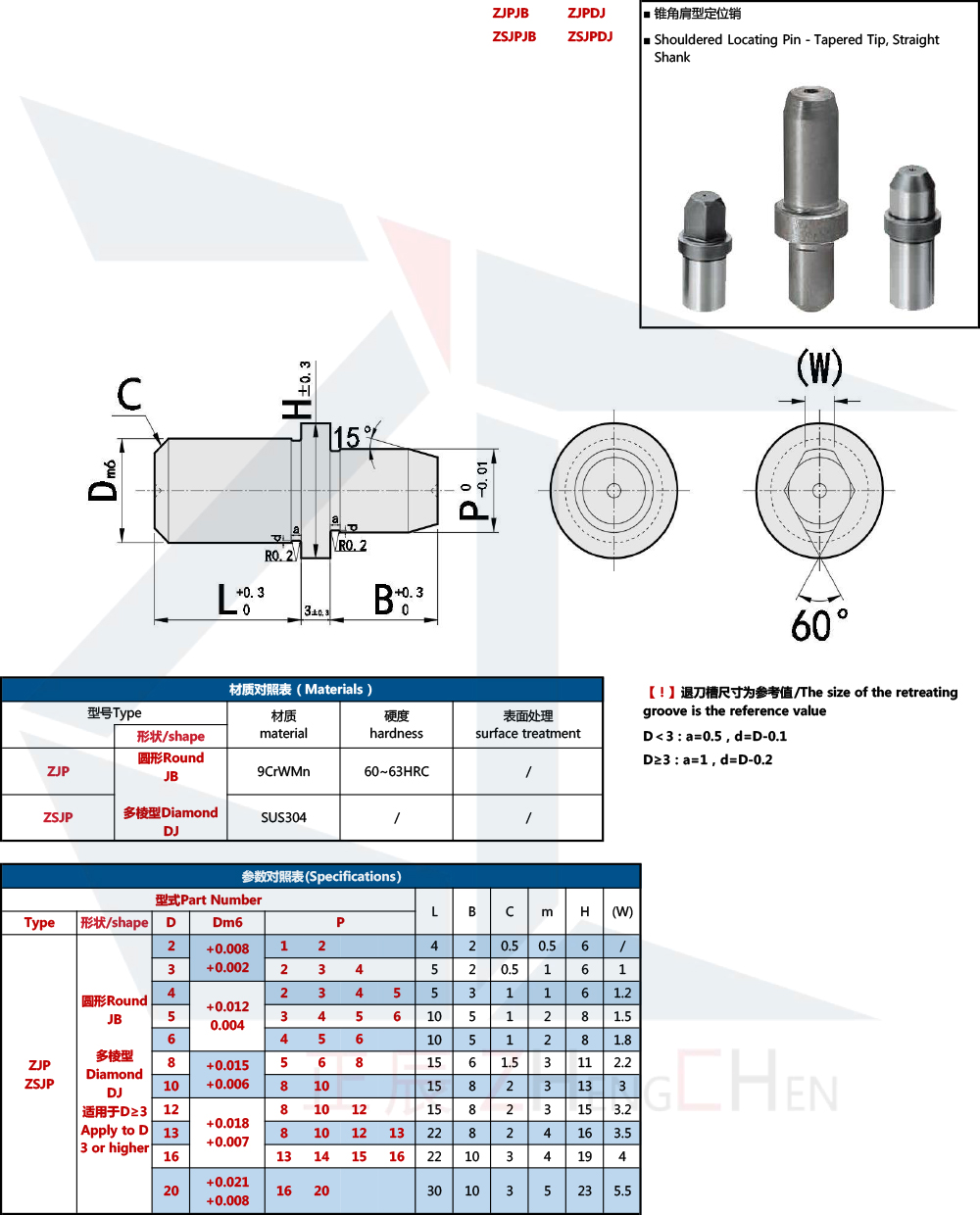
Shouldered Locating Pin - Tapered Tip, Straight Shank
Use dowel pins as pivots, hinges, shafts, jigs, and fixtures to locate or hold parts. For a tight fit, your hole should be equal to or slightly smaller than the diameter shown. Breaking strength is measured as double shear, which is the force required to break a pin into three pieces.
Shouldered Locating Pins with the taper-shaped head.
Some combinations are not available. Refer to the availability list to select the available combination.
Introducing our precision Locating Pin, the ultimate tool for ensuring accurate alignment in any fixture. Whether you're working on a complex project or need to quickly align two pieces of a fixture, our Locating Pin is the perfect solution. Our pins are crafted with the highest quality materials and are designed for long-lasting durability, ensuring that they will withstand even the toughest jobs.
Our precision Locating Pins can be used to locate a workpiece on a fixture, or to align two pieces of a fixture. Featuring a precision design, our pins are accurate to within thousandths of an inch, ensuring that your workpieces are always aligned perfectly. With our Locating Pins, you can save time and increase productivity by reducing setup times and ensuring that your workpieces are properly aligned before you begin your work.
If you're looking for a reliable and durable Locating Pin, look no further than our precision Locating Pin. With its precision design and high-quality materials, it's the perfect tool for any professional looking to improve accuracy and productivity. Order now and experience the difference our Locating Pins can make in your work today!


1.How long is your delivery time?
Generally our delivery time is 15 to 30 days . But different products and quantities have different procedures andtiming.we promise that we'll try our best to finish your orders within the shortest time.For more information, pleasecontact us.
2.ls the MOQ fixed?
For most orders,the MOQ can't be lowered according to the required quantities.For stock items,the quantities canbe negotiated.
3.What is the Surface Treatment?
Galvanized, Yellow zinc plated,H DG.
4.What is your material?
stainless steel and carbon steel .It also can according to your requirements.
5.Where is the port of shipment?
FOB:Shenzhen or HongKong.
6.What are your terms of payment?
PAYMENT BY T/T IN ADVANCE , West union,Paypal and etc.
7.Are customized products accepted?
You idea and imagine,we design and make.lt is fully self-customized.
8.Any discount possible if l place an order?
Yes,we have different price ranges (discounts)according to your quantities.You can consult us anytime.
9.Shipping
For samples or small order, can be delivered by express of DHL, UPS, FedEx,TNT, HKDC at the buyerconvenience, or by other express to save the buyer cost or shorten the transit time at the buyer request.& For mass order delivery, can be optional with terms of Ex-work, FOB by air or by sea based on the buyerforwarder or our recommended local forwarder at the buyer convenience.
To save the buyer shipping cost, we can also offer Chinese cheap cost from our local fonwarder for our buyer moreselections.
Frequently asked questions about this product (FAQ)
1. Will the positioning pins rust? If so, are there any measures to prevent it?
Positioning pins without surface treatment and non SUS3 series materials can rust. It is recommended to regularly apply rust preventive oil for maintenance or purchase positioning pins with surface treatment, which can prevent rust in normal atmospheric environments. Please refer to this for details
2. Why is there a undercut in the neck of the positioning pin?
Because of its high coaxiality, the neck also needs to be ground. The neck grinding process requires a back groove to ensure that the rib of the positioning pin does not produce an R angle.
3. Can shapes and sizes beyond the specifications recorded in the catalog be customized?
Can be customized with special attention. However, please provide drawings and have certain requirements for quantity when customizing. Details can be consulted jennyguo@fazcwj.com
4. Is a full inspection conducted during the quality management of positioning pins?
Strictly inspect each process link. And conduct a full inspection of the main process steps. Conduct a full inspection upon final shipment.
In precision fixture design and machining setups, managing lateral forces without compromising workpiece positioning is a daily reality on the shop floor. Relying on standard detent components for lateral workholding often leads to pin binding, premature wear, and workpiece deflection.
Mold assembly precision directly dictates manufacturing throughput. Minor component failures cause catastrophic tool damage, unacceptable scrap rates, and severe production bottlenecks. Engineers face constant challenges on the floor.
Quick positioning, alignment, indexing, and securing components in sheet metal or thin-walled enclosures presents a strict mechanical limitation. You face insufficient material thickness to support standard threaded hardware.
Specifying the wrong spring plunger often results in micro-misalignments, premature component wear, or catastrophic part ejection failures during high-speed machining and automation cycles.
In precision engineering, the reliability of positioning, indexing, and holding mechanisms depends entirely on the point of contact between the plunger and the workpiece.
Component failure in indexing, positioning, or ejecting mechanisms frequently traces back to a single engineering oversight: specifying the wrong material for the operating environment.
The relentless demand for miniaturization in medical devices, aerospace components, and consumer electronics requires mechanical hardware that fits microscopic footprints without sacrificing tactile feedback, holding force, or the ability to facilitate easy positioning and removal of parts.
Precise component positioning in mechanical assemblies dictates the difference between seamless indexing and mechanical binding. A fraction of a millimeter in plunger travel matters. Engineers must control this movement to ensure reliable machine operation.
Standard plungers fail on angles. Learn to specify spring plungers for sloped surfaces to manage side loads, prevent binding & ensure precision.
Prevent thread wear during frequent assembly. Discover how a spring plunger set screw configuration protects fixtures in dynamic environments.
Eliminate shorts and corrosion. Discover how engineering plastic spring plungers deliver reliable electrical insulation and chemical resistance.
Stop surface damage and reduce scrap. Discover how non-marring plastic spring plungers securely fixture delicate aluminum without scratching.
Prevent PCB damage and sensor misalignment. Learn how to specify micro spring plungers for precise positioning in high-density electronics.
Prevent sensor drift and damage. Learn how optimizing micro spring plunger contact force and tolerance guarantees precision mechanical stability.
Standard plungers failing? Discover how custom long stroke spring plungers ensure exact mechanical fit, optimal force, and reliable indexing.
Struggling with indexing or ejection failures? Discover how long-stroke spring plungers bridge extended gaps to eliminate costly downtime.
Standard parts failing? Learn how to select a custom spring plunger manufacturer for precise force curves, extreme durability, and reliable scale.
Prevent contamination and costly recalls in food processing. Discover how to specify 316L hygienic spring plungers for strict CIP compliance.
Prevent stripped threads and assembly downtime. Compare metric vs. inch spring plungers, verify tap drill sizes, and ensure flawless installation.
Specify reliable spring plungers for medical devices. Master sterilization-safe materials, micro-sizing, and custom forces for compliant assemblies.