Shoulder Screws - Low Head, Selectable Step Length
Introducing our high-quality shoulder bolt, perfect for all your mechanical needs. Made from premium materials, this bolt is designed to allow for the smooth and efficient rotation of pulleys, linkages, and other moving parts in engines and various mechanical applications.
With its sturdy construction and precise engineering, this shoulder bolt delivers unrivaled performance and reliable operation. Its innovative design ensures that your machinery works at optimal levels, reducing downtime and increasing productivity.
Our shoulder bolt is designed to meet the highest standards of quality and durability, making it ideal for use in a wide range of applications. Whether you're working on a complex engine or a simple mechanical device, this bolt is sure to provide the strength and efficiency you need to get the job done.
So why settle for anything less than the best? Choose our shoulder bolt for your next project and experience the superior performance and quality that only our product can deliver. With our commitment to excellence and customer satisfaction, you can be confident that you're getting the best value for your money. So, upgrade your machinery with our shoulder bolt and take your operations to the next level!
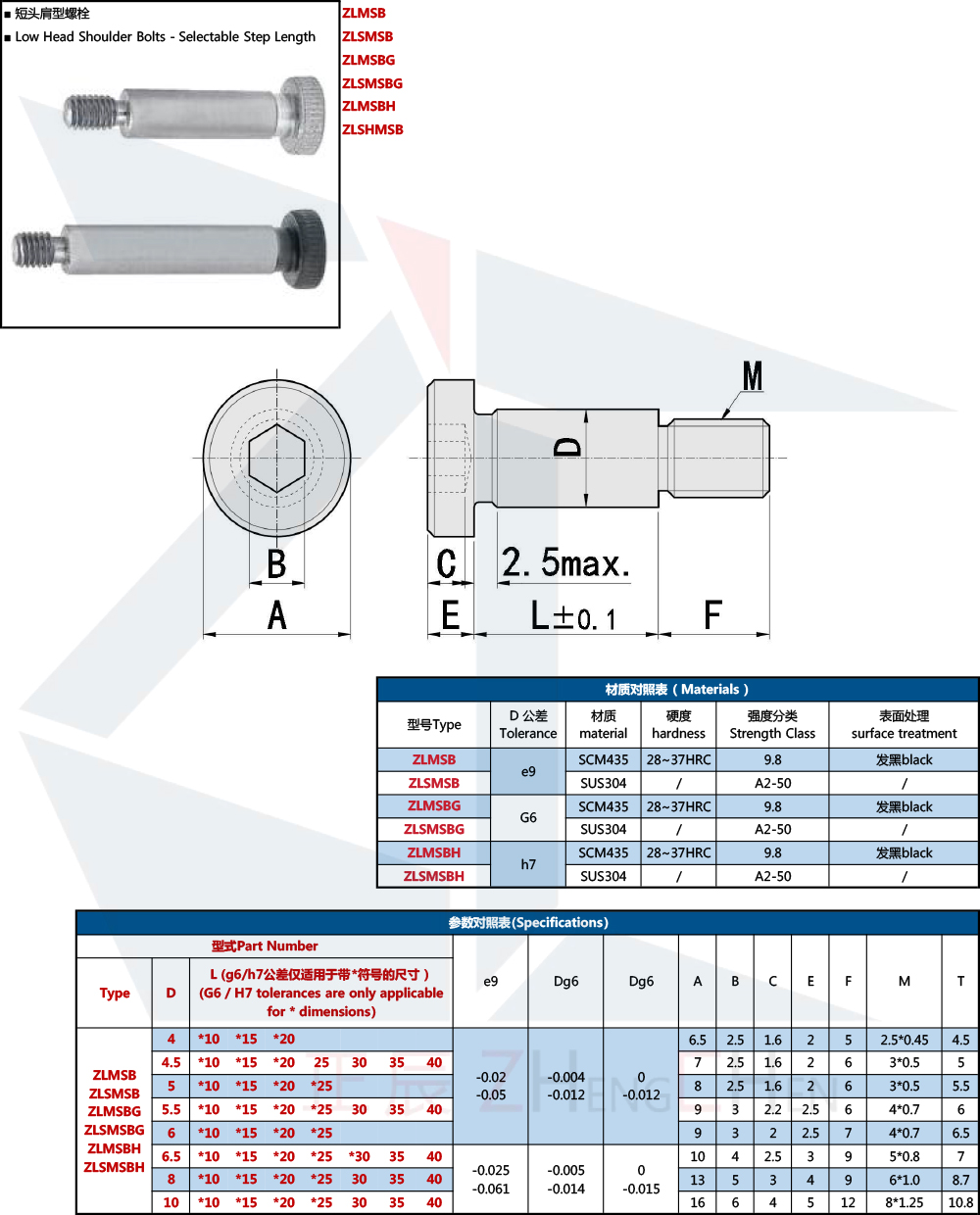


1.How long is your delivery time?
Generally our delivery time is 15 to 30 days . But different products and quantities have different procedures andtiming.we promise that we'll try our best to finish your orders within the shortest time.For more information, pleasecontact us.
2.ls the MOQ fixed?
For most orders,the MOQ can't be lowered according to the required quantities.For stock items,the quantities canbe negotiated.
3.What is the Surface Treatment?
Galvanized, Yellow zinc plated,H DG.
4.What is your material?
stainless steel and carbon steel .It also can according to your requirements.
5.Where is the port of shipment?
FOB:Shenzhen or HongKong.
6.What are your terms of payment?
PAYMENT BY T/T IN ADVANCE , West union,Paypal and etc.
7.Are customized products accepted?
You idea and imagine,we design and make.lt is fully self-customized.
8.Any discount possible if l place an order?
Yes,we have different price ranges (discounts)according to your quantities.You can consult us anytime.
9.Shipping
For samples or small order, can be delivered by express of DHL, UPS, FedEx,TNT, HKDC at the buyerconvenience, or by other express to save the buyer cost or shorten the transit time at the buyer request.& For mass order delivery, can be optional with terms of Ex-work, FOB by air or by sea based on the buyerforwarder or our recommended local forwarder at the buyer convenience.
To save the buyer shipping cost, we can also offer Chinese cheap cost from our local fonwarder for our buyer moreselections.
Frequently asked questions about this product (FAQ)
1. How can we avoid rusting of the short head shoulder type bolt?
If there are requirements for rust prevention, please choose stainless steel materials or surface treatment products with non electrolytic nickel plating. Otherwise, regular application of rust prevention oil is required to prevent rusting.
2. How to avoid the occurrence of thread breakage when tightening short shoulder bolts?
Please tighten the bolts within the tightening torque range, otherwise excessive torque may cause thread breakage.
Please click on the tightening torque specification table for details
3. How to customize the L length of the middle step for higher accuracy?
LTC machining specifications can be added to the product, that is, the specified value of L size can be precise to 0.1 units.
4. Is there a thread at the root of the short shoulder screw and can it be tightened to the end?
The root of the threaded part of the standard model already has a machined undercut groove, which can be directly screwed onto the fixed seat of the hand.
Specifying fastening hardware in load-bearing environments carries incredibly high stakes. Mechanical failure is simply not an option. You rely on these components to hold massive structures and critical machinery together under immense stress.
Specify the wrong dimensions for a push button locking pin, and the assembly either fails to lock entirely or suffers from excessive axial play. This loose tolerance accelerates mechanical wear. The most common point of failure in procurement involves confusing "overall length" and "grip length."
Exacting engineering environments leave absolutely no room for guesswork. A fraction of a millimeter often determines whether an assembly holds under immense pressure or fails catastrophically.
In mission-critical applications—from aerospace rigging to medical structural supports—the failure of a quick-release fastener is not just a maintenance nuisance. It is a system-level vulnerability. Engineers often over-index on static shear strength when evaluating these components.
Industrial engineers often face a frustrating terminology paradox. You might hear procurement teams use hardware terms loosely. They ask for ball lock pins today. They ask for push button pins tomorrow. They assume these represent completely different fastening systems.
In precision industrial environments, every second of assembly time counts. Engineers require reliable, tool-less fastening solutions. You need components built for speed and absolute security. The push button locking pin meets this demand perfectly.
Manual fastening in high-vibration or load-bearing environments often forces a difficult engineering trade-off. Technicians must usually choose between maximum physical security and rapid operational speed. Traditional threaded fasteners require tedious manual tightening.
A push button locking pin acts as a critical failure point in high-load, fast-assembly environments. From aerospace assemblies and line array audio systems to heavy lifting and industrial Lockout/Tagout (LOTO) protocols, these small components carry massive operational stakes.
Push button locking pins appear as incredibly simple, reliable mechanisms at first glance. Yet, specifying the wrong pin compromises structural integrity, operator safety, and overall application efficiency. Even a minor oversight can lead to catastrophic system failure.
Selecting the exact right positive locking mechanism demands a rigorous balance. Engineers must weigh rapid manual actuation against sheer strength and environmental resilience. For decision-makers, the stakes remain incredibly high.
A push button locking pin is often a low-cost component. Yet, it frequently secures high-value industrial assets. Sizing errors carry severe operational consequences. They lead to excessive machine downtime. They cause mechanical binding during daily assembly.
Engineers constantly seek efficient ways to secure moving parts in complex assemblies. A push-pull spring plunger serves as a critical mechanical component for indexing, positioning, and locking these mechanisms seamlessly.
Engineers often drop a detent pin into a design blindly. You might expect it to handle whatever mechanical forces come its way. However, this assumption introduces severe mechanical risks.
Designing mechanical assemblies often hinges on a single, vital interaction point. You must perfectly match a spring plunger to its mating surface. This tiny engagement zone dictates the tactile feel and reliability of the entire mechanism.
Manufacturing thrives on absolute precision and repeatable actions. Engineers constantly seek reliable mechanical components designed to apply accurate, repeatable spring end-forces in tooling, fixtures, and automated machinery.
Repeatable precision in manufacturing, tooling, and product assembly depends heavily on minor mechanical components. They must function reliably over thousands of continuous cycles to prevent production halts.
In precision machinery and industrial applications, choosing the right mechanical locking or positioning component is critical for reliability, safety, and efficiency. Two common devices used for positioning and locking are indexing plungers and ball lock pins.
Indexing plungers are vital mechanical components used to secure, position, and lock movable parts in machinery, fixtures, jigs, and industrial equipment.
Custom indexing plungers are essential components in specialized machinery, industrial equipment, and precision assemblies.
Indexing plungers are essential mechanical components used across various industries to ensure precise positioning, secure locking, and repeatable alignment in machinery, fixtures, jigs, and other adjustable assemblies.