| Availability: | |
|---|---|
| Quantity: | |
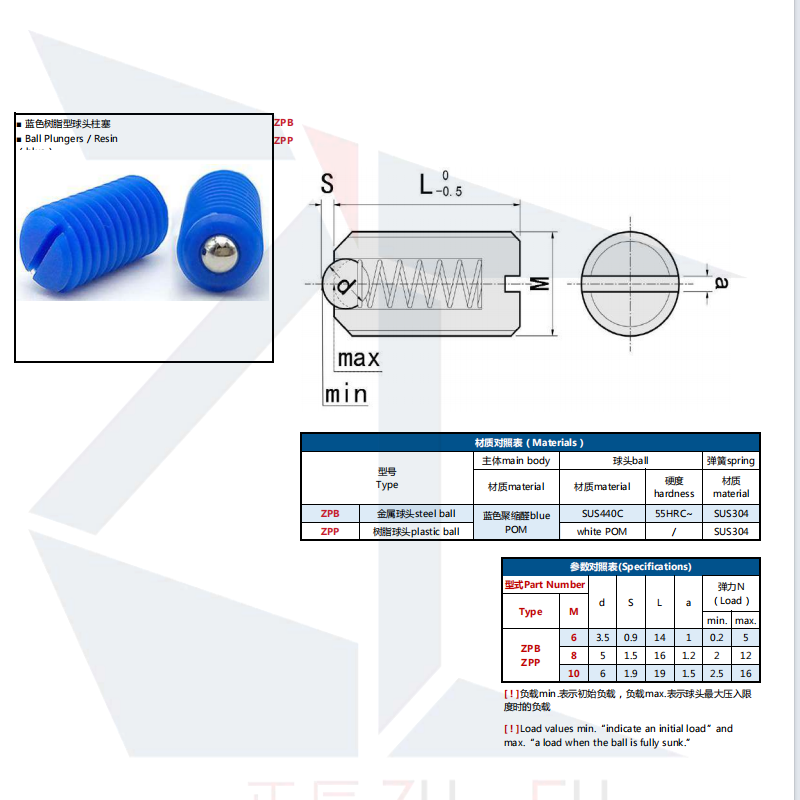
One of the key features of our Ball Plunger is its versatility. It can be used in a wide range of applications, from simple indexing and positioning tasks to more complex mechanical operations. The ball provides a point contact, which allows for precise movement and positioning. The spring-loaded design ensures that the ball remains in contact with the mating surface, even under varying loads and vibrations. Our ball plungers are available in a variety of sizes, shapes, and materials, allowing customers to choose the most suitable option for their specific needs. Some models also offer adjustable spring forces, providing further flexibility in different applications. Additionally, the threaded body makes it easy to install and remove the ball plunger, saving time and effort during assembly and maintenance.
The advantages of our Ball Plunger are numerous. Its versatility makes it a cost-effective solution for many industries, as it can be used in multiple applications without the need for different components. The precise movement and positioning capabilities ensure accurate operation, reducing errors and improving productivity. The spring-loaded design provides reliable performance, even in harsh environments, as it can withstand vibrations and shocks. The use of high-quality materials ensures a long service life, reducing the need for frequent replacements and minimizing downtime. The easy installation and removal process also contribute to the overall efficiency of the assembly and maintenance process. Moreover, our ball plungers are backed by a team of experienced engineers who can provide technical support and advice to ensure optimal performance.
Our Ball Plunger finds extensive applications in various industries. In the automotive industry, it is used for indexing and positioning components during assembly, ensuring precise fit and function. In the machinery manufacturing sector, it is employed for quick-release mechanisms, tool holders, and other applications where a reliable and easy-to-use locking solution is required. It is also commonly used in the electronics industry for holding and positioning circuit boards and components. Additionally, the ball plunger is suitable for applications in the aerospace, medical, and food processing industries, where precision and reliability are of utmost importance. In the furniture industry, it can be used for drawer stops and other types of positioning mechanisms.
Q: What is the maximum load capacity of the Ball Plunger?
A: The maximum load capacity of our Ball Plunger depends on the specific model and design. Generally, it can range from a few kilograms to several hundred kilograms. For detailed information on the load capacity of a particular model, please refer to the product specifications or contact our sales team.
Q: How do I install the Ball Plunger?
A: Installing the Ball Plunger is relatively simple. First, select the appropriate size and type of ball plunger for your application. Then, drill a hole with the correct diameter and depth in the mating surface. Thread the ball plunger into the hole using a suitable tool, such as a wrench or a screwdriver. Make sure to tighten the ball plunger firmly to ensure a secure fit. If you need to adjust the spring force, follow the instructions provided in the product manual.
Q: Can the Ball Plunger be customized?
A: Yes, we offer customization options for our Ball Plunger. We can customize the size, shape, material, spring force, and other features according to your specific requirements. Please contact our sales team to discuss your customization needs, and our engineers will work with you to develop a solution that meets your expectations.
In precision machinery and industrial applications, choosing the right mechanical locking or positioning component is critical for reliability, safety, and efficiency. Two common devices used for positioning and locking are indexing plungers and ball lock pins.
Indexing plungers are vital mechanical components used to secure, position, and lock movable parts in machinery, fixtures, jigs, and industrial equipment.
Custom indexing plungers are essential components in specialized machinery, industrial equipment, and precision assemblies.
Indexing plungers are essential mechanical components used across various industries to ensure precise positioning, secure locking, and repeatable alignment in machinery, fixtures, jigs, and other adjustable assemblies.
Indexing plungers are essential components in mechanical assemblies, offering precise positioning, locking, and alignment capabilities. They are widely used in machinery, jigs, fixtures, and industrial equipment, where accurate positioning and repeatable movement are critical.
TIME/VENUE:2026.3.31-4.3 Shenzhen International Conventionand Exhibition Center (Bao'an)BOOTH NO.3-P10
If an indexing plunger starts sticking, failing to seat, or wearing out early, replacing it might "solve" the symptom—but not the cause. Most field issues come from receiving-hole design, alignment stack-up, contamination, or side loading.
In harsh environments, "indexing plunger" is not the full spec. The real spec is: corrosion risk + cleaning method + contamination tolerance + maintenance reality. If you don't design around those, even a premium plunger will feel gritty, stick, or corrode before its expected service life.
"Load rating" sounds simple until a pin bends in the field and everyone asks why. Indexing plunger pins rarely fail from pure axial force. They fail because real assemblies introduce shear, bending, misalignment, and vibration—often all at once.
A standard indexing plunger is designed to re-engage automatically. That's great—until it isn't. In fast changeovers, rotating plates, or safety-critical adjustments, you may need the opposite behavior: the pin must stay retracted until the operator intentionally releases it.
When an indexing plunger "doesn't feel reliable," the issue is often not the plunger. It's the hole. Bore size, chamfer, and engagement depth decide whether the pin finds the target smoothly—or fights burrs, edge damage, and misalignment for the rest of its life.
Did you know that using the wrong set screw can cause permanent damage to delicate components? Whether you're working with polished aluminum, plastic housings, or precision assemblies, a traditional metal set screw might scratch, deform, or even crack your components.
What do medical devices, precision electronics, and high-end furniture have in common? They all require non-marring, precision fastening solutions—and nylon tip set screws are the go-to choice.Standard fasteners often cause more harm than good in delicate assemblies.
Did you know that a single fastener can determine whether your assembly lasts for years or fails within weeks? It's not always about the size or strength of the screw—it's about the application fit. In industries where surface integrity, vibration control, and precision are essential, the nylon tip set screw is often the unsung hero.
"One wrong screw can ruin your entire assembly." That's not an exaggeration—it's a reality many engineers and manufacturers face when choosing between different types of fasteners. Imagine tightening a set screw into a soft aluminum or plastic surface, only to find cracks, scratches, or permanent damage.
In many industries, fastening delicate components without causing surface damage is a constant challenge. That's where nylon tip set screws come in — a smart and reliable solution for non-marring, vibration-resistant fastening.
When you use a sliding door or open a drawer, you can feel the smooth stop and click. This comes from the ball head plunger and spring plunger inside. A high-quality ball head plunger uses strong materials like 304 stainless steel. This gives you better durability and protects against rust.
You use a plastic ball plunger to move parts gently. Material is important. POM and PA work for everyday jobs. PEEK is better for hot or tough places. Ball plungers keep electronics and molds safe. They protect soft surfaces.
Hygiene is very important in food processing. Every part, even a stainless steel ball plunger, must meet hygiene rules. Clean machines help keep food safe for people. Picking parts that resist germs and rust means you can trust your equipment for years.
You use spring ball plunger technology to get steady preload and close tolerances in your automation equipment. Spring-loaded plungers help you get exact positioning. This makes design and performance better.